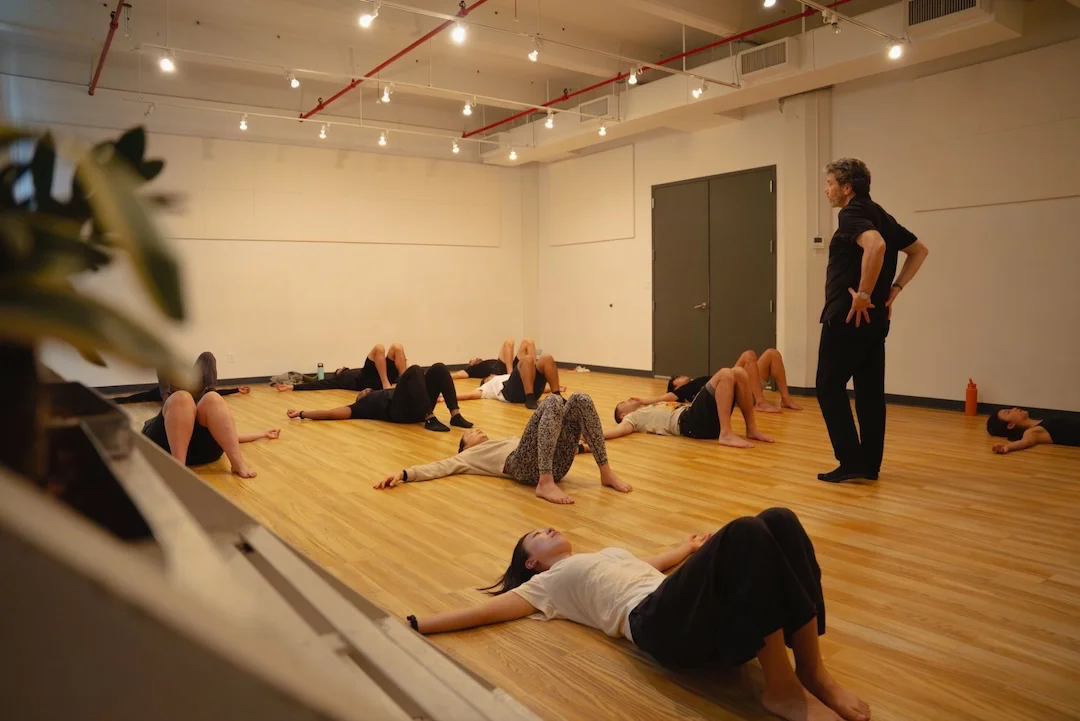

What if voice training had less to do with sounding “right” and more to do with becoming more available, more connected, and more fully yourself? That question sits at the heart of a recent conversation between Terry Knickerbocker, founder of Terry Knickerbocker Studio (TKS), and Matthew Dudley, a Meisner-trained actor and longtime voice faculty member at TKS whose work is deeply rooted in the Linklater tradition. Together, they explore how freeing the natural voice helps actors connect breath, imagination, language, emotion, and truthful acting.
TL;DR: Freeing the natural voice means releasing the tension, habits, and self-consciousness that prevent an actor’s authentic voice from moving freely. In this article, Terry Knickerbocker and Matthew Dudley explain why Linklater voice technique, breath work, resonance, and consistent practice are essential for actors who want to communicate truthfully on stage, on camera, and in the room with another person.
What Does “Freeing the Natural Voice” Mean?
Freeing the natural voice means releasing the voice you already have, rather than forcing yourself into a polished or standardized sound.
The phrase comes from Kristin Linklater’s foundational book, Freeing the Natural Voice, which helped shape generations of voice training for actors. The basic idea is simple but demanding: the actor’s voice does not need to be manufactured from the outside. It needs to be uncovered.
In the conversation, Matthew describes his work as helping actors become aware of their own voice. Through that awareness, actors begin to know themselves more fully and tell a story with more depth, clarity, and authenticity.
That is why the Linklater voice technique is not about sounding impressive. It is about allowing breath, vibration, thought, feeling, and imagination to move through the body without unnecessary tension.
As Matthew puts it, the goal is not to use the voice to describe a story, but to “reveal the imagination.”
For actors, that distinction matters. A corrected voice can sound clean but disconnected. A freed voice can carry thought, impulse, feeling, and relationship. It gives the actor access to something more alive.
Why Voice Training Matters for Actors
Voice training for actors matters because acting is not only internal; it has to be communicated.
At TKS, Terry talks about actors as makers. Actors make behavior. They take language, imagination, body, breath, and relationship and turn them into something another person can receive. Voice work is part of that making.
Many film and television actors wonder whether voice training is necessary. After all, they have microphones. The camera is close. Why not just speak naturally?
Terry challenges that assumption. In film and television markets, he has often seen actors become dependent on microphones and confuse quietness with truth. The result can be a kind of faux naturalism: behavior that looks relaxed on the surface but lacks vibration, specificity, and real connection underneath.
Voice work for actors is not about becoming louder. It is about becoming more specific.
When the camera is close, the actor’s thought has to be clear. When the scene is intimate, the language still has to live. Breath, vibration, resonance, and speech help the actor bring inner life into the space between themselves and the listener.
That is why voice training belongs inside actor training, not beside it as a decorative extra. The actor’s voice is part of the full instrument.
Breath, Vibration, and Resonance: The Foundation of Voice Work
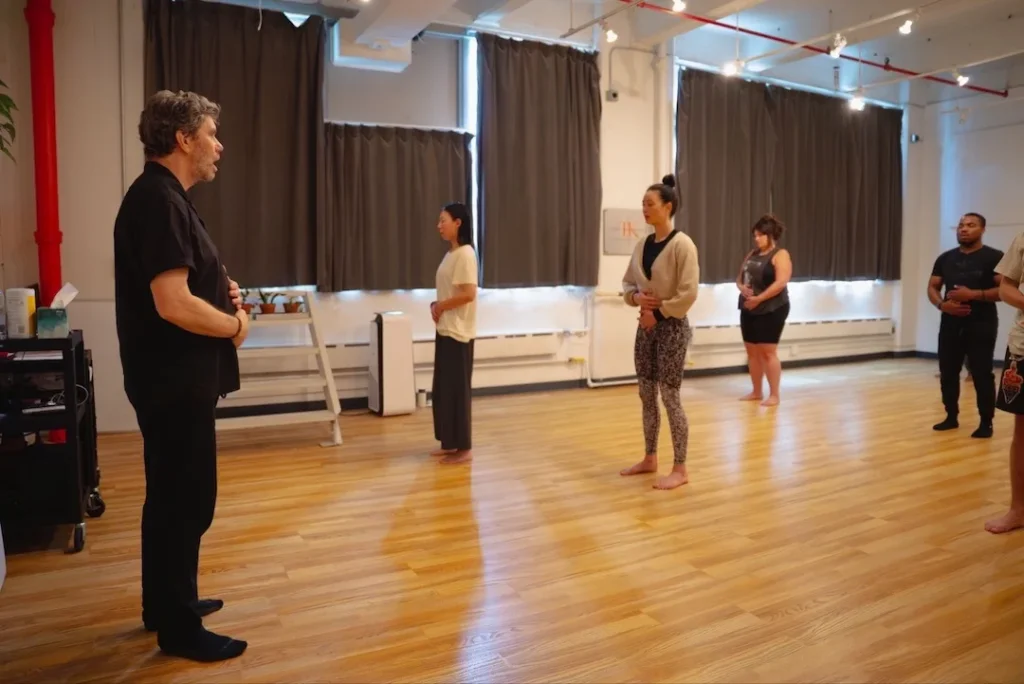
Breath is the foundation of voice because it gives actors a physical pathway into sound, impulse, and connection.
Matthew describes breath as a “blueprint for experiencing voice.” Once an actor can begin to sense breath in the body, the work can move into vibration: where the actor feels sound, where it gets held, and how it might move forward.
In Linklater-based voice work, this progression is practical. Actors begin with awareness. Where is the breath moving? Where is it blocked? Is the sound sitting back in the throat? Can it move into the mouth, onto the lips, and eventually toward another person?
Matthew describes the pathway simply: breath, vibration, and then sound landing on somebody else.
That final step is important. Resonance is not just about producing a beautiful tone. It is about transmission. The actor’s voice has to arrive somewhere. It has to reach a scene partner, an audience member, the camera, or the room.
At TKS, this work begins with deceptively simple exercises. Actors may lie on the floor, notice the movement of the ribs, sense breath in the back, or become aware of places in the body they have never considered before.
For many actors, that first discovery is humbling. They know they breathe, but they have not yet experienced breath as part of their craft.
How TKS Connects Linklater Voice Technique and Meisner Training
At TKS, voice training is distinctive because it is woven into a Meisner-based acting environment.
Matthew is not teaching voice in a silo. He is a Meisner-trained actor who teaches voice to actors. That matters because the work is always connected to listening, responding, impulse, relationship, and truthful acting.
The Meisner Technique asks actors to live truthfully under imaginary circumstances. Linklater voice work supports that goal by helping the body become available enough to receive and respond.
Can the actor let breath in? Can they take in the other person? Can they allow what they feel to move through them instead of capping it in the throat? Can they speak from the body without pushing, hiding, or performing the idea of emotion?
These are acting questions as much as voice questions.
In the conversation, Terry notes that when the instrument has more possibilities, the stories get richer. Matthew adds that the relationship between Meisner and Linklater at TKS is especially alive because both lineages are close to the source and both serve the actor’s ability to live truthfully.
That is the point of the work: not a lovely voice for its own sake, but a voice that helps the actor tell the truth with another human being.
Voice One, Voice Two, and Bringing Speech to Life
Voice training develops in stages: awareness first, expansion next, and then a deeper relationship to speech, language, and text.
Matthew describes Voice One as the beginning of awareness. Actors start to understand how their voice works, what habits they carry, and which behaviors may be limiting their ability to speak clearly, fully, and with connection.
Voice Two builds from that foundation. Once actors know more about their own breath and vibration, they can begin to explore where the voice lands and how far it can travel.
Voice Three, which Matthew calls “bringing speech to life,” moves into the sounds of language. Actors begin working with vowels, consonants, speech, dialects, and accents. The goal is not to flatten the actor’s voice into a standard sound. The goal is clarity, self-knowledge, and full communication.
That progression matters because voice training is not a quick technical adjustment. It is a way of building a relationship with the actor’s instrument over time.
An actor who understands breath, vibration, resonance, and language has more choices. They can meet the demands of a script with greater freedom, specificity, and range.
Clarity Is Not Accent Reduction
The goal of voice training is clarity and connection, not the erasure of an actor’s identity.
Terry speaks directly about older models of “standard American” speech and accent reduction. Those approaches can imply that where an actor comes from, and how they sound, is something to correct.
TKS approaches the question differently.
If an actor has a regional or cultural accent, the question is not, “How do we erase this?” The question is, “Are you connected to your speech? Are you speaking what you know? Is the audience receiving what you are saying?”
If the audience cannot understand the actor, then there is work to do. But that work is about awareness, choice, and communication. It is not about conformity.
An actor’s voice carries history, culture, memory, identity, and imagination. Voice training for actors should deepen that connection, not remove it.
That is why clarity and specificity are more useful goals than accent reduction. They help actors remain fully themselves while making sure the story reaches the listener.
Common Vocal Habits Actors Bring Into the Room
Common vocal habits are not personal failures. They are patterns actors can learn to notice, explore, and release.
Matthew notes that many actors arrive in voice class having never really thought about their voice. Others arrive actively disliking it. Both starting points require a new conversation.
One common habit is vocal fry. Rather than naming it as a flaw, Matthew treats it as a current expression of the voice that may have limitations. The question becomes: where is the breath? Where is the vibration? Is the sound sitting back in the throat? What happens if the actor allows the voice to move forward?
Other common habits include holding the breath, pushing, under-articulating, speaking from the throat, and performing a casual naturalness that is not actually connected to impulse or thought.
Linklater voice exercises help actors approach these habits with curiosity rather than judgment. The work is not about shaming the voice. It is about discovering what else is possible.
As those habits soften, the actor gains access to more breath, more resonance, and more truthful expression.
Why There Are No Quick Fixes in Voice Training
Voice training is a practice, not a one-time correction.
In the conversation, Terry compares inconsistent practice to cramming before a music lesson. Two hours the morning of class is not the same as steady daily work. Matthew agrees and describes encouraging students to begin with small, regular periods of practice that build over time.
The point is not to make actors think about breath, tongue tension, or resonance while they are acting. The point is the opposite.
With consistent practice, the work starts to become part of the actor’s instrument. Habits begin to shift. New pathways form. The actor can enter acting class or rehearsal prepared, available, and less distracted by technique.
This is where craft becomes freedom.
The beginning may be simple: a breath, a small sound, a moment of curiosity. It may not feel dramatic. It may not feel immediately exciting. But repetition gives that small beginning somewhere to grow.
For TKS, that long-game approach is central. Actors are not training for a single good class or a single good audition. They are building sustainability, longevity, and a process they can return to throughout their lives.
How Voice Work Helps Actors Become More Emotionally Available

Voice work helps actors stay physically open when emotion becomes intense.
Many actors have the experience of feeling something strongly and then losing the ability to communicate. The throat tightens. The breath stops. The body braces. The feeling is present, but the expression gets blocked.
In the conversation, Matthew explains that practice helps actors know their own bodies and voice tendencies well enough to let breath drop in and communicate through feeling rather than be overtaken by it.
Terry connects this to a simple but powerful acting idea: the body can be soft even when the emotion is fierce.
That does not mean the actor feels less. It means the actor has more space for the feeling to move. Rage, grief, joy, fear, and longing can travel through the instrument instead of getting trapped in it.
This is where voice work and truthful acting meet. The actor is not manufacturing emotion. They are building the capacity to let human experience move through breath, body, voice, and language.
Matthew describes the voice as a reflection of the self: love, fear, dreams, ambition, history, and memory. Training gives the actor access to that fuller self so they can bring more humanity to the text.
Train for Excellence
Voice training is part of a larger commitment to excellence.
Terry and Matthew push back against the idea that “just working” is the highest goal. It is possible to get jobs without deep training. It is possible to be visible without craft. But TKS is interested in something more lasting.
The question is not only, “Can I get work?” The deeper question is, “What kind of actor am I becoming?”
Training gives actors a way to honor their talent, the writer, the audience, and the art form itself. It builds the capacity to create performances that are specific, alive, and memorable.
For actors who want to do more than get by, voice work is not optional decoration. It is part of learning how to live out stories with the body, breath, imagination, thoughts, heart, and voice.
As Terry says in the conversation, “Let’s train for excellence.”
Key Takeaways
- Freeing the natural voice means releasing tension and habit so the actor’s authentic voice can move more freely.
- Linklater voice technique helps actors connect breath, vibration, resonance, language, and imagination.
- Voice training for actors supports film, television, and stage work because it builds specificity of thought and clarity of expression.
- At TKS, voice work is connected to Meisner-based acting, so the work serves listening, impulse, emotional availability, and truthful acting.
- The goal is clarity and communication, not accent erasure or a standardized sound.
- Consistent practice helps actors build a sustainable craft that can support them throughout their training and professional lives.
Frequently Asked Questions
What does freeing the natural voice mean?
Freeing the natural voice means releasing the tension, habits, and self-consciousness that block an actor’s authentic voice. It is not about inventing a new voice or forcing a “better” sound. It is about uncovering more freedom in the voice the actor already has.
Why is voice training important for actors?
Voice training is important for actors because acting has to be communicated through the body, breath, language, and sound. It helps actors build clarity, resonance, presence, emotional availability, and specificity of thought whether they are working on stage or on camera.
What is the Linklater voice technique?
The Linklater voice technique is a progressive approach to voice training that helps actors release physical tension and connect breath, vibration, resonance, and language. For actors, the work supports vocal freedom, imaginative expression, and a more truthful relationship to text.
How does breath affect an actor’s voice?
Breath is the foundation of voice because it supports sound, impulse, and emotional availability. When breath is restricted, the voice can become trapped, pushed, or disconnected. When breath is freer, the actor has more access to resonance, language, and connection.
What is the connection between voice work and truthful acting?
Voice work supports truthful acting by helping the actor stay open, responsive, and physically available. When breath and sound can move through the body, the actor is better able to communicate thought and feeling without forcing, hiding, or shutting down.
How do Meisner and Linklater techniques work together?
Meisner training asks actors to listen, respond, and live truthfully under imaginary circumstances. Linklater voice work supports that by freeing the body and breath so the actor can receive, respond, and speak with greater openness. At TKS, the two approaches work together as part of the actor’s full instrument.
Is voice training only important for theater actors?
No. Voice training is important for film and television actors too. A microphone can capture sound, but it cannot create specificity of thought, emotional availability, or vocal presence for the actor. Those qualities come from training.
What are common vocal habits actors need to release?
Common vocal habits include holding the breath, speaking from the throat, pushing, under-articulating, vocal fry, and performing a casual naturalness that is not actually connected. These habits are not personal failures. They are patterns actors can become aware of and gradually shift through practice.
Is accent reduction the goal of voice training?
No. The goal is not accent reduction or the erasure of an actor’s identity. The goal is clarity, connection, self-awareness, and expressive freedom. An actor’s voice is personal, cultural, and imaginative, and voice training should help that voice communicate fully.
How long does it take to develop a stronger, freer voice?
There is no single timeline. Voice training is a long-term practice. Even short, consistent daily work can help actors build new habits over time, but the work continues to deepen throughout an actor’s training and career.
Explore Voice Training at TKS
If you are ready to explore how breath, resonance, and truthful acting come together, learn more about voice training for actors at Terry Knickerbocker Studio.
You can also explore how the Meisner Technique shapes actor training at TKS, or learn more about the two-year professional acting conservatory.